

The Competencies That Matter in Cybersecurity Education for High Schools
This blog post was written by Jason Rausch, SVP of Instructional Development at PLTW.
In today’s technology-driven landscape, higher-order skills are not supplemental to cybersecurity instruction; they are foundational to it. Even so, PreK–12 cybersecurity pathways and classes are often framed primarily around technical knowledge, tools, configurations, and procedures. While technical proficiency is essential, this framing is incomplete.
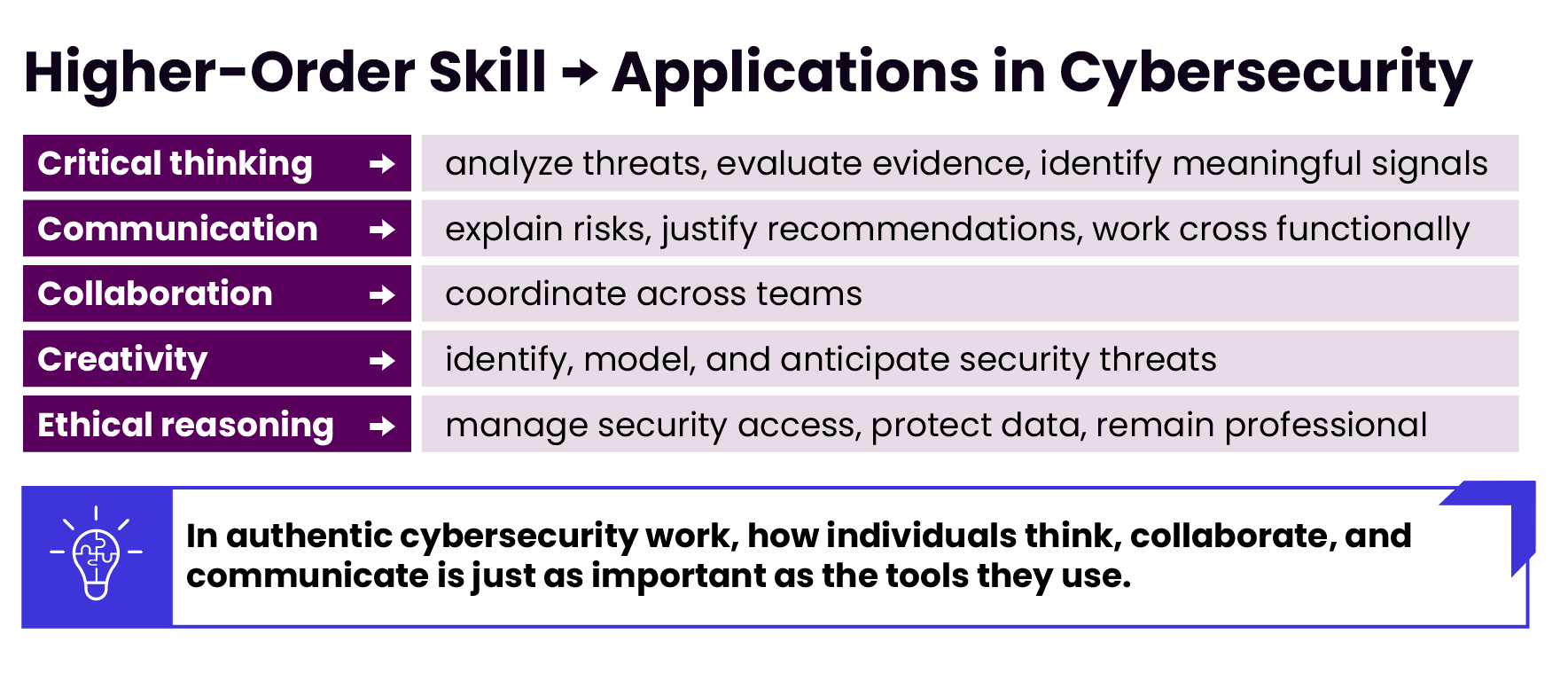
In authentic cybersecurity work, how individuals think, collaborate, and communicate is just as important as the tools they use. Critical thinking, collaboration, communication, creativity, and ethical reasoning are central to how cybersecurity professionals identify problems, interpret evidence, and make responsible decisions. For students to be successful, their learning experiences must reflect the realities of the work, not just its surface-level technical components.
Higher-Order Skills in Real Cyber Work
How can students prepare for a career in cybersecurity? These future-ready skills are essential.
In professional cybersecurity environments, problems are rarely well-structured or clearly defined. Analysts must investigate ambiguous situations, reconcile conflicting indicators, and determine appropriate responses in collaboration with others.
These conditions place sustained demands on higher-order skills:
-
Critical thinking is required to analyze system behavior, evaluate evidence, and distinguish meaningful signals from noise.
-
Communication enables cybersecurity professionals to explain risks, justify recommendations, and support decision-making across technical and non-technical audiences.
-
Collaboration reflects the team-based nature of cybersecurity work, which routinely involves coordination across IT, engineering, operations, and leadership.
-
Creative thinking supports adversarial reasoning, threat modeling, and the anticipation of novel attack patterns.
-
Ethical reasoning guides responsible access, data protection, and professional conduct.
These skills are not abstract or optional; they are operational competencies embedded in daily cybersecurity practice. Instruction that treats them as generic “soft skills” divorced from technical learning misrepresents how cybersecurity work is actually performed.
PLTW's Approach: Authentic, Skill-Integrated Preparation
This understanding has directly informed the design of the PLTW Cybersecurity course. Rather than separating technical instruction from skill development, the curriculum integrates higher-order skills within scenario-based, hands-on challenges that mirror professional workflows.
In the course, students engage in realistic roles such as analyst or incident responder and are expected to:
-
Investigate systems and networks
-
Analyze logs, traffic, and vulnerabilities
-
Collaborate to interpret findings
-
Document and present conclusions
-
Consider ethical and professional implications of their actions
Through these experiences, students learn that cybersecurity is not about isolated tasks or tools, but about reasoned decision-making in complex systems. Teachers consistently reflect that PLTW’s approach shifts student understanding of the field from a focus on mastering techniques to building an appreciation for the investigative, collaborative, and responsibility-driven work of cybersecurity professionals.
Higher-order skills develop most effectively when they are inseparable from technical problem-solving, rather than taught as transferable proficiencies to be applied later. Through PLTW’s hands-on cybersecurity learning and career-connected experiences, students gain real experience they can use in college, career, and life.
Prioritizing Depth Over Coverage
As the field evolves, pressure to expand technical coverage remains a persistent challenge in PreK–12 cybersecurity education. That’s especially true in schools with educators who need additional training or are teaching beyond their area of expertise.
PLTW’s experience across diverse school contexts suggests that continually adding content is neither sustainable nor effective. Learners who can reason about systems, evaluate evidence, communicate uncertainty, and make ethical judgments are better prepared to adapt across technologies and roles.
To help students build career-ready cybersecurity skills, depth of thinking and authenticity of experience should take precedence over breadth of tools in CTE cybersecurity pathways. These competencies endure beyond specific platforms or tools and align more closely with real workforce expectations.
Closing the Career Readiness Gap in Cybersecurity
Online safety, network security, and prevention of cyberattacks are critical priorities in every industry. Yet, even as cybersecurity workforce demand rises, research shows only 60% of public high schools offered a foundational computer science course in the 2024–25 school year—and just 6.1% of students enroll in those classes each year
PLTW Cybersecurity provides everything schools need to help students learn higher-order skills they need to stay safe in a tech-driven world, even if they don't choose a career in computer science. And our curriculum-aligned training gives educators the confidence to facilitate active, hands-on learning that prepares students not just to perform tasks, but to think and act like cybersecurity professionals.
Want to expand access to certifications like CompTIA Security+ and cybersecurity jobs? Explore the PLTW Cybersecurity course.
Any opinions expressed are those of each guest author.