
There’s a new wave of high-tech manufacturing in the United States and it’s creating a “once-in-a-generation opportunity” for rural communities. From semiconductors and electronics to biomanufacturing and clean technology, the manufacturing process in facilities is expanding fast. And they’re bringing the kind of high-demand, high-wage careers that can help revitalize local economies.
Nearly two-thirds of $1 trillion in advanced-manufacturing investments will be located within 15 miles of rural America, according to a McKinsey analysis. This anticipated growth surfaces a critical question for school and district leaders: Are our students prepared to step into the high tech, in-demand roles of Industry 4.0?
With the right mix of strong foundational academics, industry-aligned career and technical education (CTE), and local partnerships, districts can enable a well-equipped workforce and capture the opportunity in front of rural America.
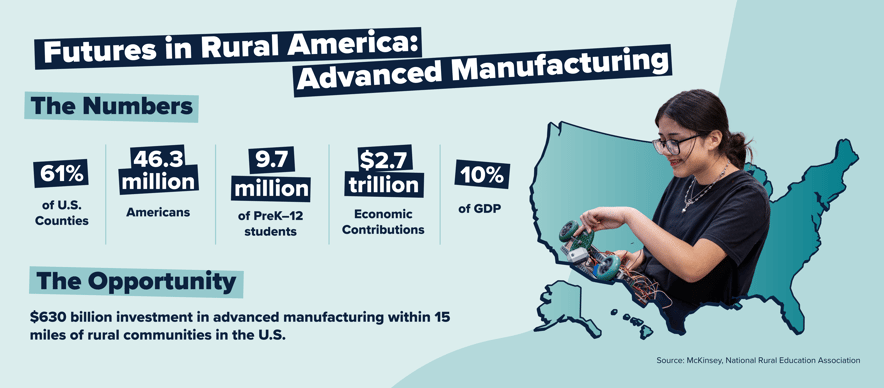
The Impact of Manufacturing Workforce Development in Rural America
Over the past few years, manufacturing in the U.S. has accelerated dramatically. Between 2020 and 2024, annual construction spending on manufacturing facilities surpassed $150 billion—a record-breaking, nearly threefold increase according to McKinsey.
These shifts toward technology-driven careers could boost wages by $34 billion a year, with three groups benefiting most:
- Local K–12 graduates hired to fill incoming advanced manufacturing jobs
- Existing manufacturing workers who stay in their jobs, especially those who upskill
- Indirect and induced wages spurred directly by manufacturing investments
Rural School Districts Are Critical in Developing Job Skills—But They Need the Right Tools
As innovation moves closer to rural students, educators have a chance to create locally relevant advanced manufacturing pathways to careers that evolve alongside innovation. McKinsey identifies two essential levers in PreK–12 education:
- Strong foundational job skills that are applicable across roles and professions, including literacy, math, and critical thinking—whether students pursue a college degree or entry-level job roles.
- Evidence-based, relevant learning such as career and technical education (CTE) courses, dual enrollment, apprenticeships, and career academies that are tailored to local industry needs and provide certification opportunities in advanced manufacturing training.
How Rural CTE Programs Can Become a Pathway for Real-World Career Opportunities
Even as companies make investments in new industrial facilities and state-of-the-art technology, industry leaders are increasingly concerned about available talent. If trends continue, McKinsey estimates the U.S. could face a shortage of 2.1 million workers by 2030.
Professionals in this field are skilled technicians, operators, and problem-solvers who work with robotics, artificial intelligence (AI), advanced materials, and digitally connected environments. However, advanced manufacturing jobs don't all require a four-year degree. Many employers accept industry-recognized credentials (IRCs) and provide on-the-job training, making these careers more accessible to students who are ready to enter the workforce right after graduation.
For high school CTE programs, adding an advanced manufacturing course is a game-changer. McKinsey points out that CTE programs boost graduation rates, improve employability, and lead to significantly higher wages. And strategic partnerships can help schools fund these much-needed learning experiences.
Build Partnerships that Support Advanced Manufacturing Pathways in High Schools
Strategic collaborations can help schools fund and upgrade CTE programs as industries evolve, ensuring classroom learning reflects real workforce experiences and future career opportunities. Here are some ways to create mutually beneficial partnerships that bring together students and community:
- Advisory, Competition, and Sponsorship Support: Build a local advisory committee and invite employers to serve as competition judges or project reviewers—an easy on-ramp to deeper engagement.
- Work-Based Learning: Develop internships, job shadows, youth apprenticeships, mentorships, and capstone projects that introduce students to modern manufacturing environments and work experiences.
- Facility Tours and Classroom Visits: Arrange tours of nearby facilities and invite industry professionals to speak about their work and career paths in a classroom Q&A.
- Equipment and Training Partnerships: Explore shared equipment, donations, or training collaborations that benefit both students and professionals.
- Grants and Fundraising: Connect with economic development groups, workforce boards, and STEM-focused organizations that invest in rural innovation and talent pipelines.
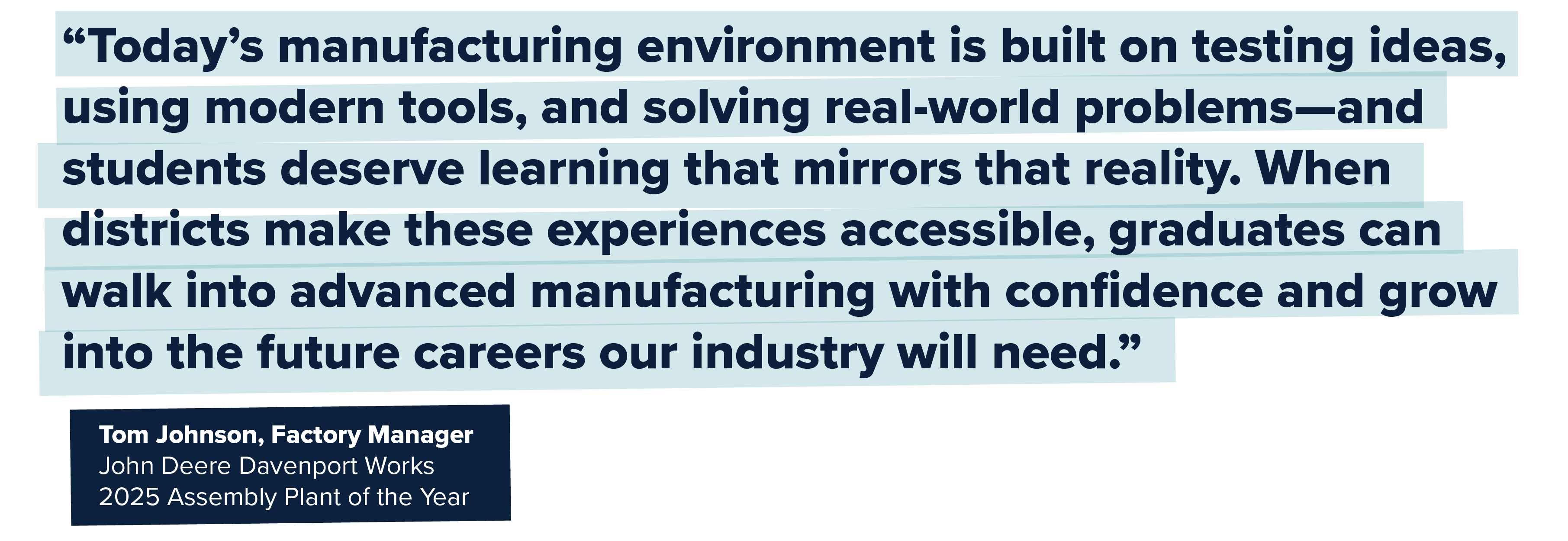
How PLTW Curriculum Aligns with McKinsey’s Recommendations
Career-connected learning is most powerful when it’s hands-on, relevant, and built for tomorrow’s workforce; these experiences are crucial for igniting student interest in any profession or pathway. PLTW’s Advanced Manufacturing course is designed for students in grades 10–12 and immerses learners in Industry 4.0—where semiconductors, automation, AI, machine learning, cyber-physical systems, robotics, and data analytics come together to solve real problems.
Developed in partnership with industry experts, this year-long course helps districts build a future manufacturing workforce by strengthening both technical knowledge and durable, transferable skills that prepare students for what’s next.
Download the Infographic →
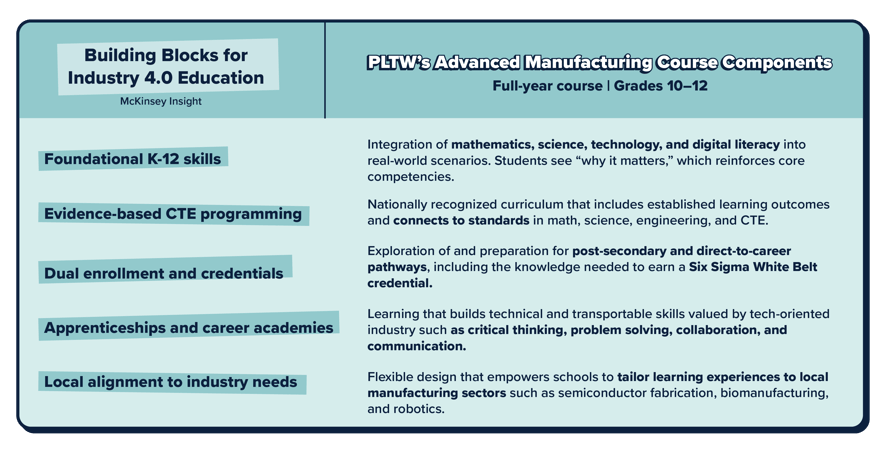
Prepare Your High School Students for Post-Secondary Manufacturing Careers
McKinsey’s analysis paints a compelling scenario: rural communities revitalized by advanced manufacturing. But it’s only possible when schools and businesses work together to equip students for high-value jobs close to home.
By implementing an industry-backed advanced manufacturing course, rural districts don’t merely adapt; they seize the opportunity to empower students, fuel local economies, and embark on purposeful career journeys.
Discover how PLTW’s Advanced Manufacturing course can elevate career-connected learning when you download the course outline or connect with our team.